

Where can I find a list of Headshot Photographers?
AGENTS
If you have an agent
– ask your agent for a list of their preferred headshot photographers
– discuss your photoshoot with your agent (each agents has do’s and don’ts, likes and dislikes)
.
eBOSS CANADA – INDUSTRY DIRECTORY
The eBOSS Directory contains a list of headshot photographers across Canada
Click the provinces below to find a photographer near you.
– ALBERTA
– BRITISH COLUMBIA
– MANITOBA
– ONTARIO
– QUEBEC
– SASKATCHEWAN
.
VANCOUVER ACTOR’S GUIDE
The Vancouver Actor’s Guide provides a list of photographers in British Columbia
https://www.vancouveractorsguide.com/listings/photographers
.
NOTE: If you are a headshot photographer and your company is not in the eBOSS Directory
– It is FREE to add your company to the Directory
TO ADD YOUR COMPANY TO THE DIRECTORY (Free Basic Listing)
– Click https://www.ebosscanada.com/advertise
– Click the Free Package
– Follow the onscreen steps to add your company information
.
If we’ve missed something or you’d like to see a topic added, we’d love your feedback.
Click here to share your suggestion
https://www.ebosscanada.com/contactus
What is the correct format for an Actor’s Resume
If you have an agent – ask your agent for an example of the resume format they prefer.
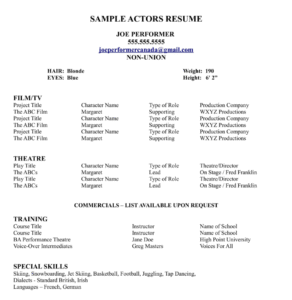
If you do NOT have an agent – see the example below for guidance
SAMPLE RESUME FOR A NON-REPRESENTED PERFORMER
See the terms at the bottom of the page (below the resume)
SAMPLE RESUME IN JPG FORMAT
SAMPLE RESUME IN PDF FORMAT
.
Role Types – Film
Actor: The actor has five or less lines of dialogue. A line is 10 words or less. So if you have a longer speech, every 10 words would be considered a line.
Lead: The actor appears in most scenes. Their role is central to the story.
Supporting: The actor fills a principal role and appears in one or more scenes. Although important to the storyline, the role is not a lead character.
Principal: In film, this term refers to a speaking role, without specifying how central the character is to the story. It is also used to denote non-contract players who have five or more lines.
Featured: The actor has one scene with one or more lines; not significant enough to be considered a supporting role and could be cut from the final version of the film. If the role remains, the actor’s name appears in the end credits.
.
Role Types – TV
• Series Regular: The actor is under exclusive contract with the show to appear (or be paid regardless of appearing) every week.
• Recurring: The actor returns as the same character in multiple episodes.
• Guest Star: The actor appears in a single episode, with a character whose storyline is central to that particular episode.
• Co-star: The actor appears in a single episode, the character may or may not be central to that episode’s storyline.
.
Commercial Credits
• List your commercial credits as “LIST AVAILABLE UPON REQUEST”
• This is appropriate even if you only have one commercial on your resume!
• The reason for not listing commercials is to avoid naming past projects that may conflict with the product or company you’re currently auditioning for.
.
Education and Training
Education and training should take up no more than one-third of your resume.
• It’s encouraged to include the names of instructors you’ve worked with.
• Having respected and recognizable names on your résumé enhances credibility — and these individuals may serve as potential references!
.
Special Skills
Special Skills are abilities you perform exceptionally well — so well that someone would hire you to do them!
Categories and how to list them:
SPORTS/DANCE/INSTRUMENTS
Include your experience level or how many years you’ve been studying or practicing the skill.
LANGUAGES:
Indicate whether you’re Conversational or Fluent.
ACCENTS:
Only list accents you can perform confidently and on command.
.
If we’ve missed something or you’d like to see a topic added, we’d love your feedback.
Click here to share your suggestion
https://www.ebosscanada.com/contactus