

Are agents allowed to charge an administration fee?
NO
Talent agents are not allowed to charge “registration” or “annual maintenance” fees — except in the case of background agents, who may charge a one-time registration fee of up to $100.00, and only during the first year of representation.
SOURCE: EIC CODE #19: https://eictalentagents.ca/code-of-conduct/
.
If we’ve missed something or you’d like to see a topic added, we’d love your feedback.
Click here to share your suggestion
https://www.ebosscanada.com/contactus
How much commission do I pay an agent?
An agent will negotiate a representation agreement with the prospective client at the time of signing, which will include a detailed commission structure. An agent will not charge more than 15% commission for film, TV, and digital work. Commissions are not charged on auditions.
Any extraordinary expenses (including, but not limited to, photo reproductions, demos, union dues, permits, or casting breakdown services) paid by the agent must have the client’s prior approval. These expenses will be reimbursed by the client once receipts for the incurred costs are provided.
SOURCE: EIC CODE #17: https://eictalentagents.ca/code-of-conduct/
.
If we’ve missed something or you’d like to see a topic added, we’d love your feedback.
Click here to share your suggestion
https://www.ebosscanada.com/contactus
5 Red Flags in Talent Agency Contracts
The following article is written for actors in the USA, but it contains important information relevant to all actors.
Note 1: The article references SAG-AFTRA — in Canada, the unions for actors are ACTRA and UBCP/ACTRA.
Note 2: The article mentions a 20% commission — in Canada, the standard commission for agents is 15% for film, TV, and commercial work.
5 RED FLAGS IN TALENT AGENCY CONTRACTS
https://www.alisonhaselden.com/blog/5-red-flags-in-talent-agency-contracts
.
If we’ve missed something or you’d like to see a topic added, we’d love your feedback.
Click here to share your suggestion
https://www.ebosscanada.com/contactus
My agent insists that I use their “in-house” photographer and pay them (the agent) for the shoot – is this acceptable?
This is NOT acceptable or ethical.
An agent must not require a client to use any specific photographer, printer, school, or other service provider as a condition of representation.
SOURCE: EIC CODE #12: https://eictalentagents.ca/code-of-conduct/
TAMAC CODE OF ETHICS:
It is not a condition of representation that an agent stipulates the photographer, printer, school or any other service provider for the client. Should an agent have any financial interest in above named businesses, full disclosure about said interest must be provided.
Source: https://tamac.ca/faqs.php
.
If we’ve missed something or you’d like to see a topic added, we’d love your feedback.
Click here to share your suggestion
https://www.ebosscanada.com/contactus
Is my agent allowed to cash my cheques?
Yes, in Canada, talent agents are permitted to receive and process payments on behalf of their clients, including cashing cheques. However, this practice is subject to specific regulations and best practices designed to ensure transparency and protect performers’ earnings.
National Regulations
Across Canada, talent agents typically receive payments from producers or employers on behalf of their clients. They are allowed to deduct their agreed-upon commission (commonly up to 15%) before forwarding the remaining amount to the performer. It’s important to note that agents should not charge additional fees beyond the agreed commission unless explicitly authorized by the client.
British Columbia Specifics
In British Columbia, talent agencies must adhere to the Employment Standards Regulation, which outlines specific requirements:
Commission Limits: Agents may charge a maximum of 15% commission on the gross earnings of their clients.
Timely Disbursement: Agencies are required to pay their clients within five business days of receiving payment from a local source, or within 12 business days if the payment is from outside the province.
Record-Keeping: Agencies must maintain detailed records of all transactions, including amounts received, fees deducted, and payments made to clients.
Best Practices for Performers
Clear Contracts: Ensure your representation agreement outlines payment processes, commission rates, and any other fees.
Stay Informed: Regularly review your pay statements and maintain open communication with your agent regarding any concerns.
Direct Deposit: Whenever possible, opt for direct deposit to receive payments promptly and securely.
If you suspect any misconduct or have concerns about your agent’s handling of payments, consider reaching out to your local performers’ union or a legal advisor for guidance.
.
If we’ve missed something or you’d like to see a topic added, we’d love your feedback.
Click here to share your suggestion
https://www.ebosscanada.com/contactus
What is a Power of Attorney?
A Power of Attorney is a legal document that you sign to give one person—or more than one person—the authority to manage your money and property on your behalf. In most parts of Canada, the person you appoint is called an “attorney.” That person does not need to be a lawyer.
.
SOURCE: canada.ca
.
If we’ve missed something or you’d like to see a topic added, we’d love your feedback.
Click here to share your suggestion
https://www.ebosscanada.com/contactus
Do I have to sign a Power of Attorney with my Agent?
No, you are not required to sign a Power of Attorney with your agent.
In Canada, it is not standard practice for actors to grant Power of Attorney to their agents. A Power of Attorney is a legal document that gives someone the authority to manage your finances or property — and it is not necessary for talent representation.
In lieu of a full Power of Attorney, some agents will have a clause in their contracts which gives that agent authority to negotiate, endorse the Client’s name upon and deposit cheques payable to the Client for any work into the Agency trust accounton behalf of the performer.
Some agents have a LIMITED Power of Attorney form or clause within their contracts.
Your agent may require you to sign a representation agreement outlining terms such as commission, duration, and responsibilities — but this is very different from a Power of Attorney.
Important:
If an agent asks you to sign a Power of Attorney, it is strongly recommended that you seek legal advice before proceeding. This could be a red flag, especially if it gives the agent control over your finances beyond industry norms.
.
If we’ve missed something or you’d like to see a topic added, we’d love your feedback.
Click here to share your suggestion
https://www.ebosscanada.com/contactus
What is a Limited Power of Attorney
A Talent Agent’s Limited Power of Attorney (LPOA) is a legal authorization that allows an actor’s agent to act on their behalf for specific professional purposes — but only within clearly defined limits.
A Limited Power of Attorney in the entertainment industry gives a licensed talent agent permission to:
Negotiate and sign contracts related to acting or modeling work (e.g., commercials, film, TV, theatre, endorsements).
Collect and forward payments owed to the performer from production companies, casting agencies, or payroll services.
Submit and withdraw the performer’s name or materials for roles or projects.
The “limited” part means the authority is restricted to career-related activities and cannot be used for unrelated personal or financial matters.
Key Features:
It’s signed by the performer (or parent/guardian for minors).
It remains valid only while the agency agreement is active.
It does not allow the agent to make personal decisions or access unrelated bank accounts.
It ensures that the agent can efficiently handle bookings and contracts without needing the performer’s signature every time.
.
If we’ve missed something or you’d like to see a topic added, we’d love your feedback.
Click here to share your suggestion
https://www.ebosscanada.com/contactus
What is an Agents Trust Fund
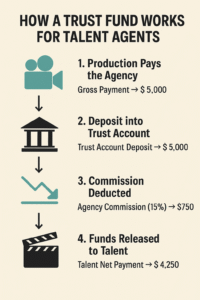
An Agent’s Trust Fund is a secure bank account where your agent temporarily holds payments from productions before sending your share to you.
It ensures your earnings are handled safely, transparently, and separately from the agency’s own funds.
In BC an Agent’s Trust Fund is mandatory.
.
When a performer is paid for a job (such as a commercial, TV role, or film), the production company often sends the payment to the talent agent first.
That money is deposited into the Agent’s Trust Account (or Trust Fund) — a separate, regulated bank account — where the agent temporarily holds the performer’s earnings.
The agent then:
Deducts their commission (usually 10–15%).
Releases the remaining balance to the performer.
Purpose:
Ensures the performer’s money is protected and handled transparently.
Keeps client funds separate from the agency’s operating expenses.
Fulfills legal and licensing requirements (in provinces like Ontario and British Columbia, trust accounts are mandatory for licensed talent agents).
In Short:
An Agent’s Trust Fund is a secure holding account that ensures an actor’s payments are properly managed, commissions are deducted fairly, and the remaining funds are safely delivered to the performer.
.
If we’ve missed something or you’d like to see a topic added, we’d love your feedback.
Click here to share your suggestion
https://www.ebosscanada.com/contactus
I worked on a job 3 months ago, I haven’t received payment from my agent. Other performers that I worked with have been paid. I contacted production and they said payment was sent to my agent. What do I do?
If you are non-union performer please immediately seek legal advice.
If you are an ACTRA Member – please contact your local ACTRA office:
.
If we’ve missed something or you’d like to see a topic added, we’d love your feedback.
Click here to share your suggestion
https://www.ebosscanada.com/contactus
Am I allowed to self-submit to casting notices that I see online when I have an Agent?
This is a conversation that you should have with your agent.
Some agents approve of their talent self-submitting, while others do not.
If you are self-submitting, ALWAYS include your agent’s name and contact number.
Never try to bypass your agent. If you have an agent, ALWAYS state your agent’s information on your submissions
.
If we’ve missed something or you’d like to see a topic added, we’d love your feedback.
Click here to share your suggestion
https://www.ebosscanada.com/contactus